
The Accounting of Organizational Empathy

I work in a profession that spends a great deal of time tracking and accounting for things.
Revenue is recorded. Expenses are categorized. Forecasts are revised. Variances are investigated. Entire careers are built on understanding where resources go, what they produce, and what they cost.
Over time, I began noticing another category of transactions that never appeared in the books:
- A manager absorbs the stress of an executive decision so her team can focus on their work
- A senior employee quietly mentors a new hire while falling behind on their own responsibilities
- A team spends months compensating for an understaffed process without formally acknowledging the burden
- A leader takes the time to repair trust after a difficult change
- Someone chooses not to speak up because the cost of honesty feels too high
None of these transactions appear on a financial statement, yet they shape organizations every day.
That was not the surprising part. Most people who have worked in organizations already know that trust, mentorship, burnout, and culture matter.
What struck me was how easily these forces disappear from view until they begin to fail.
The more I looked, the more I noticed recurring patterns. Trust seemed to accumulate and deplete. Burnout behaved like a liability. Mentorship looked suspiciously like an investment. Psychological safety increased a team's capacity to detect and respond to risk. Unresolved conflict generated costs that rarely appeared where they originated.
The language of accounting kept reappearing, not because people can be reduced to numbers, but because accounting is ultimately a practice of visibility.
It exists to reveal flows, dependencies, costs, and obligations that would otherwise remain hidden. Organizations routinely depend on trust, mentorship, emotional labor, and institutional knowledge, yet these resources often remain invisible until they have been depleted.
This essay is an attempt to describe those transactions.
Organizational empathy, as I have come to think of it, is the practice of keeping honest books on the human costs and credits of collective work.
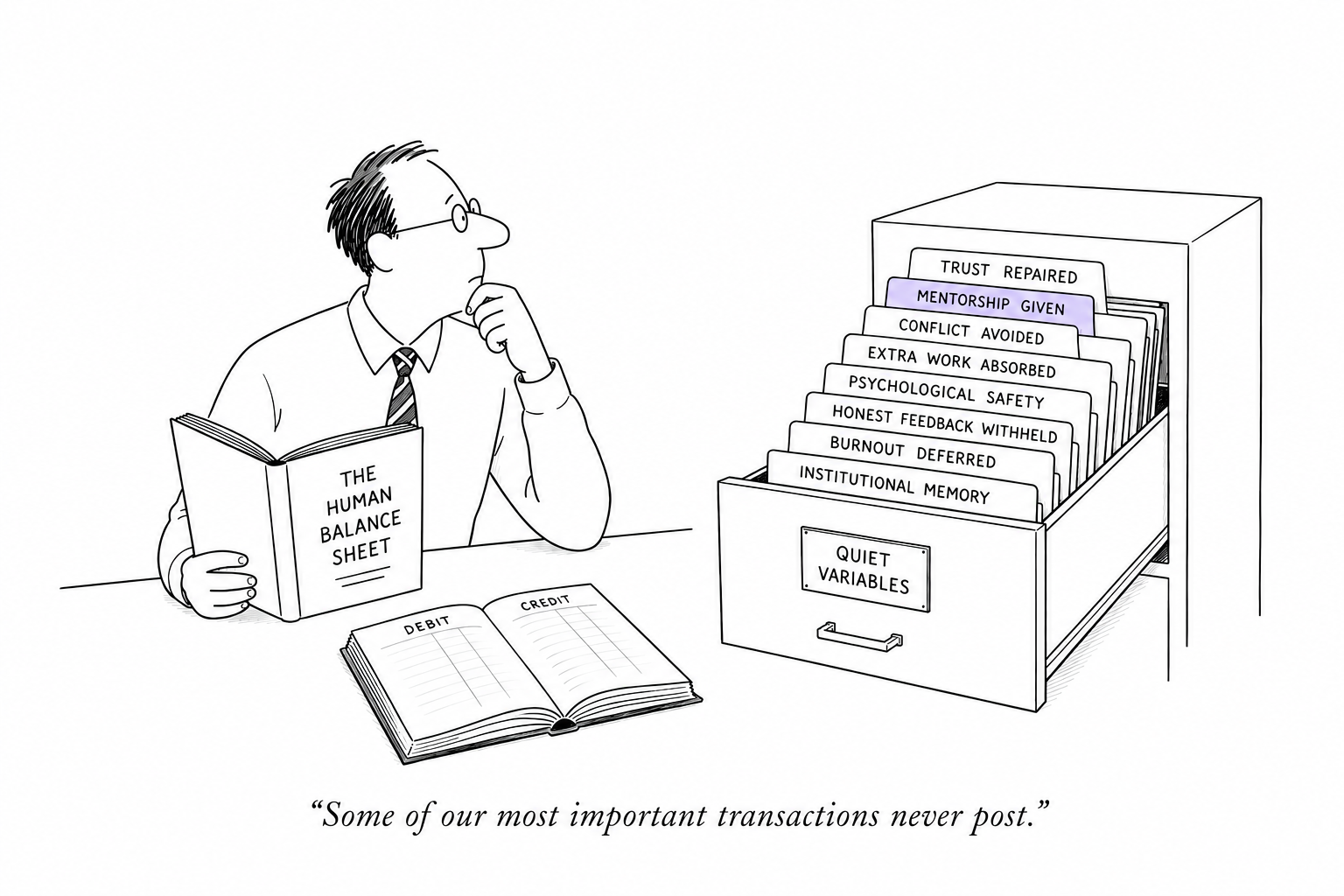
I. The Ledger No One Keeps
Every organization has two sets of books.
The first is visible. It is the formal ledger: revenue, cost, margin, headcount, utilization, attrition, productivity, operating expense. This ledger is reviewed in meetings, summarized in dashboards, defended in forecasts, and translated into decisions. It tells the organization what happened in the language of money.
The second ledger is informal, distributed, and mostly unspoken. It lives in the nervous systems of employees. It records:
- Who was protected and who was exposed.
- Who was asked to absorb ambiguity without support.
- Who carried the emotional residue of bad planning.
- Who no longer believes the organization means what it says.
This second ledger is rarely reconciled. Yet it is always being updated. The organization may not acknowledge it, measure it, or discuss it, but it records the consequences all the same.
A manager cancels a one-on-one for the fourth week in a row, and a small withdrawal is made from the account of trust. A team is praised publicly after being privately exhausted for months, and the books do not balance. A senior leader says, “We are a family,” while making decisions that treat people as replaceable inventory, and the organization records an invisible liability. Someone takes the time to explain context, absorb frustration, protect focus, or repair harm, and the system receives a deposit.
These entries may not appear on the balance sheet, but they determine what the balance sheet will eventually become.
Organizations routinely depend on trust, mentorship, emotional labor, and institutional knowledge while remaining largely blind to their creation, depletion, and transfer. The costs are real even when they are not visible.
Because people do not simply execute strategy. They metabolize it. They absorb the contradictions between stated values and lived experience. They carry the gap between urgency and capacity. They translate unclear priorities into late nights, skipped meals, tense weekends, and muted Slack threads. They convert organizational abstraction into bodily consequence.
The modern organization has become very good at measuring outcomes and remarkably poor at tracking the human resources consumed in producing them.
That limitation is not neutral. It is a form of accounting failure.
II. Empathy Is Not Soft
The word empathy has been weakened by overuse. In many organizational settings, it has come to mean politeness, warmth, emotional intelligence, or the ability to say the right thing after a difficult decision has already been made.
But empathy, in its more rigorous form, is not mere kindness. It is the disciplined attempt to understand the lived consequences of a system from the perspective of those inside it.
It asks:
Where are we calling something a performance issue when it is actually a design issue?
Who is expected to be resilient so that the structure does not have to change?
Where are we spending trust faster than we replenish it?
What does this decision feel like downstream?
Who absorbs the uncertainty?
Who pays for the delay?
Organizational empathy is not the opposite of accountability. It is what makes accountability accurate.
Without empathy, accountability becomes crude. It sees missed deadlines but not conflicting priorities, disengagement but not accumulated futility, attrition but not the long period before departure when an employee was already gone in every way (except administratively). It sees “resistance to change” but not the exhaustion of people who have been through five transformations, three reorganizations, and countless new frameworks that arrived without memory of the last ones.
An organization without empathy does not become more objective. It becomes less informed. It mistakes silence for alignment, compliance for commitment, and endurance for health.
And eventually, it mistakes collapse for surprise.
III. The Hidden Balance Sheet
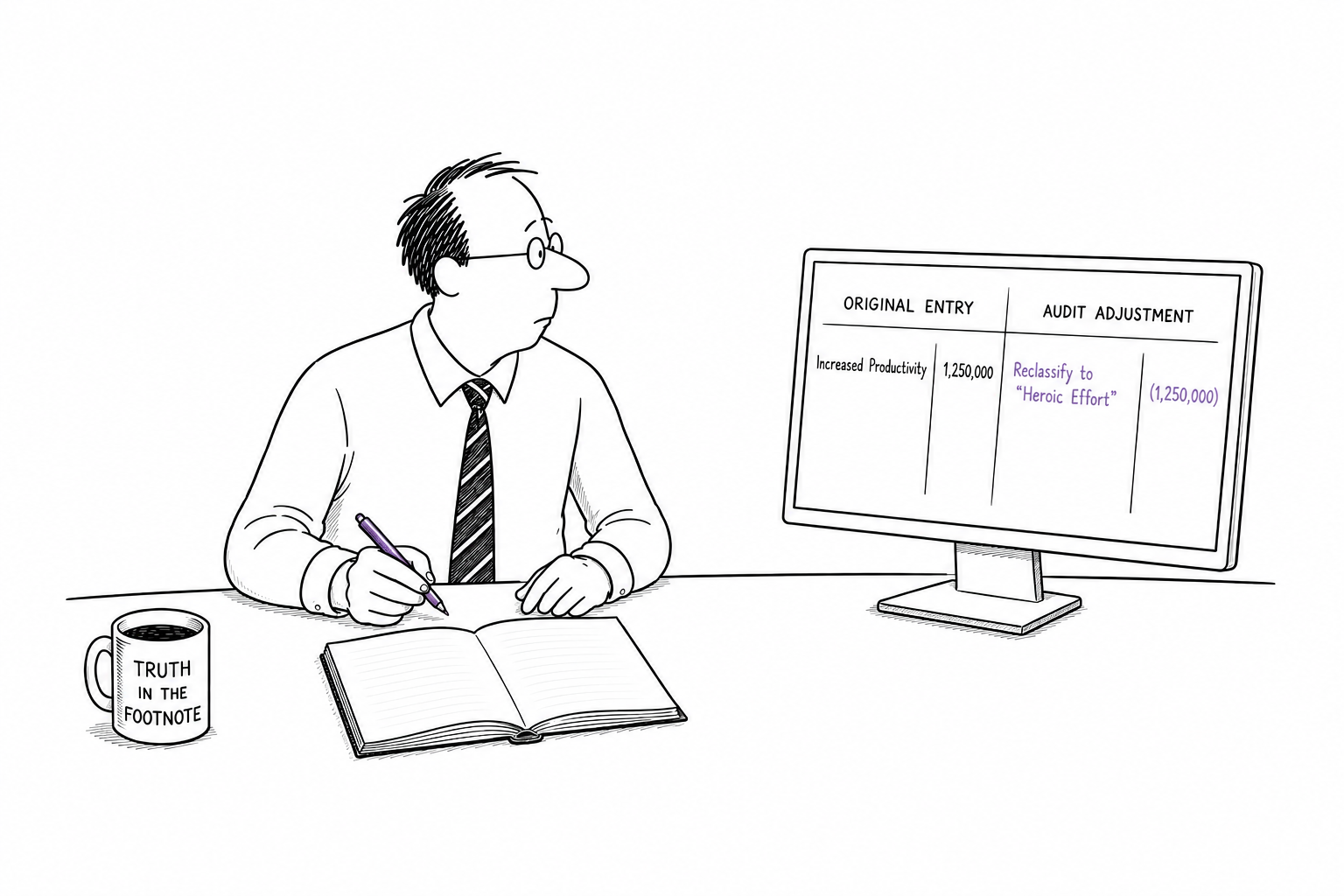
If such a thing were possible, the balance sheet of organizational empathy would not begin with cash, receivables, or inventory. It would begin with human conditions that have economic force even when they are not priced.
On the asset side, we would find trust. Not as a vague cultural aspiration, but as operational infrastructure. Trust reduces transaction costs. It speeds communication. It lowers the need for defensive documentation. It allows people to surface problems early, admit uncertainty, ask for help, and coordinate under pressure. Trust functions less like a feeling than a form of infrastructure.
We would find psychological safety, not as comfort, but as error-detection capacity. In unsafe environments, bad news travels slowly. People conceal risk, soften truth, and preserve themselves. The organization may appear calm precisely when it is becoming fragile.
We would find mentorship, institutional memory, shared language, relational credibility, and the kind of informal generosity that makes formal process survivable. These are not perks. They are productive assets.
But on the liability side, we would find debts that many organizations carry without naming:
- Unresolved conflict
- Change fatigue
- Cynicism
- Burnout
- Distrust of leadership
- Managerial inconsistency
- Performative values
- Meeting overload
- Punished honesty
- Institutional amnesia
The interest on these liabilities is expensive.
It shows up as slower decisions, lower creativity, avoidant communication, passive resistance, talent loss, and the strange heaviness that enters an organization when people still do their jobs but no longer offer their full intelligence. This is one of the great mistakes of conventional management: treating empathy as an expense rather than a form of risk management.
The absence of empathy is not efficiency. It is deferred cost.
IV. Double-Entry Humanity
Accounting is built on a simple principle:
every transaction has at least two sides.
A debit somewhere is a credit somewhere else. A gain in one account corresponds to movement in another. The books may be complex, but the logic is clear: nothing simply disappears.
Organizational life follows the same rule.
- When leadership compresses a timeline without reducing scope, the pressure does not vanish. It is transferred.
- When a company avoids a difficult conversation, the conflict does not dissolve. It moves into side channels.
- When a team is asked to “do more with less,” the “less” is not an abstraction. It becomes less recovery, less attention, less patience, less quality, less margin for error.
- When an organization celebrates heroic effort, it often fails to ask what made heroism necessary.
Every strategic decision creates a human counter-entry.
The failure to record that counter-entry is how organizations lie to themselves.
They say the launch was successful, but do not record the trust depleted by the way it was achieved. They say the restructuring improved efficiency, but do not record the confusion it created or the institutional memory it destroyed. They say engagement is down, but do not connect it to years of ignored employee feedback. They say people are resistant, but do not audit the conditions that taught people skepticism.
This is the central claim of The Accounting of Organizational Empathy: human consequences are not externalities. They are entries in the system.
The books are never empty simply because no one is looking at them.
V. Toward an Empathic Audit
An empathic audit would not ask only whether a decision achieved its intended business outcome. It would also ask what the decision consumed.
How much trust did it require?
How much ambiguity did it push downward?
How much unpaid coordination did it depend on?
Who had to translate leadership language into practical reality?
Who had to comfort, explain, stabilize, or repair?
What did the organization spend from accounts it does not formally recognize?
This kind of audit would not be sentimental. In fact, it would be more honest than many existing measurement systems because it would refuse to separate performance from conditions.
A team’s output is not independent of its emotional economy. Productivity is not independent of attention. Innovation is not independent of safety. Retention is not independent of dignity. Culture is not independent of memory.
The organization is always teaching people what it truly values (and how much of themselves it is safe to bring), regardless of what it says it values.
Every policy teaches. Every silence teaches. Every exception teaches. Every promotion teaches. Every ignored harm teaches. Every repaired breach teaches.
Over time, people learn the true accounting rules of the place. They learn which values are assets and which are decorative language. They learn whether trust earns interest or is repeatedly liquidated. They learn whether empathy is part of the operating model or merely part of the brand.
And once they learn, they adjust their investment accordingly.
VI. The Quiet Variable
The quiet variable in organizational performance is not talent, strategy, or technology alone. It is the condition of the human systems on which those advantages depend.
- Two organizations can have the same strategy and produce different outcomes because one burns trust to move faster while the other builds trust to move better.
- Two teams can have the same headcount but different capacities because one is carrying invisible debt and the other is operating from relational surplus.
- Two leaders can make the same hard decision and leave behind entirely different emotional economies depending on whether they communicate with clarity, humility, and respect.
Empathy does not eliminate difficulty. It changes the way difficulty is distributed.
It does not mean every decision will feel good. It means decisions are made with awareness of their full cost. It means leaders do not confuse power with insulation. It means the organization refuses to benefit from harms it will not name.
To account for organizational empathy is to insist that the human ledger matters. Not because people are fragile, but because systems are.
A system that cannot perceive its own human consequences cannot correct itself. A system that cannot correct itself becomes brittle. And a brittle system may look efficient right up until the moment it breaks.
The goal is not to quantify every human experience or transform empathy into another management metric. Some of the most important things resist precise measurement.
The goal is simply to notice them.
Because what organizations choose to see shapes what they are able to learn, preserve, and improve. And what they consistently fail to see does not disappear. It accumulates quietly in the background, waiting to appear elsewhere in the books.
And systems are easier to care for when we can see them clearly.
The accounting of organizational empathy begins with a simple recognition:
The human ledger is updated every day:
- In conversations that build trust
- In silences that erode it
- In moments of generosity, frustration, courage, avoidance, repair, and neglect
Most of these entries never appear in a report, yet they accumulate all the same.
And over time, they become the culture, capacity, and character of the organization itself. The books are being kept whether we acknowledge them or not.
The question is only whether we are willing to look.